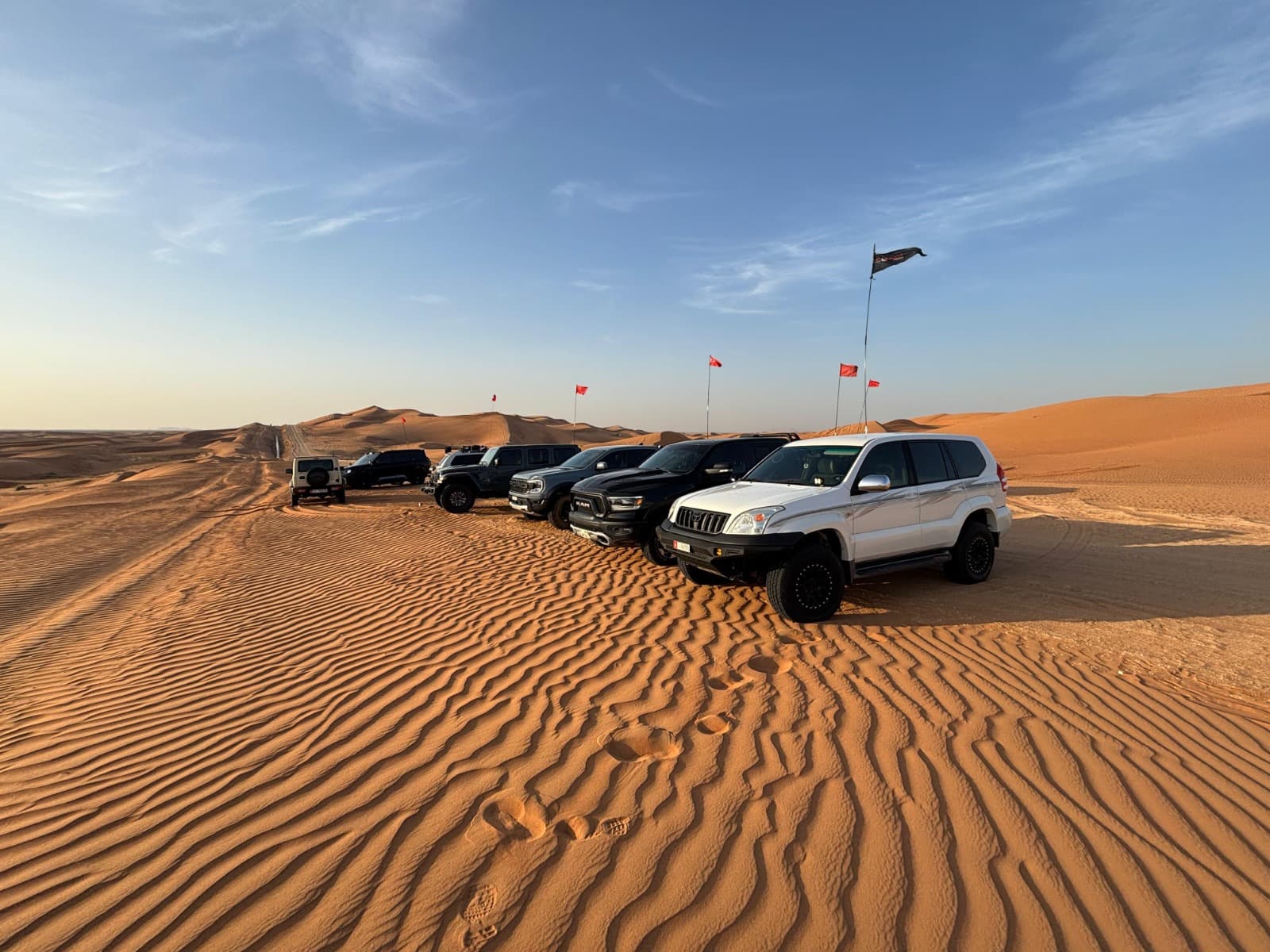
Master official trail etiquette, land use principles, driving physics, and convoy safety rules with Dubai Offroaders.
Trail Readiness Checklist
Essential land use, vehicle preparation, and group rules before turning off the road.
Never Offroad Alone (Group Rule)
Off-roading is an adventure sport with real hazards for the unprepared. There must always be at least 2, preferably minimum 3 vehicles in any group.
Extra Food, Water & Emergency Supplies
Carry surplus hydration and nutrition in case your drive runs several hours longer than planned. Keep a positive, helpful attitude—next time, it could be you.
Tread Lightly & Preserve Land
Stay on marked trails. Never drive over desert vegetation or Ghaf seedlings. Cross wadis only at designated fording points and drive over (not around) obstacles.
Leave No Trace (Pack Out Extra)
Pack it in, pack it out. Carry heavy-duty trash sacks and pack out more than you bring in. Pick up discarded water bottles and leave the desert pristine.
Get the Gate Etiquette
Leave all desert property and boundary gates the way you found them. If you open a gate to pass, always close it securely behind you.
Tyre Pressure & Compressor Ready
Deflate to 15–18 PSI for soft sand and gravel flotation. Carry a reliable 12V air compressor to safely reinflate before returning to highway tarmac.
Chassis-Mounted Rated Recovery Points
Front and rear recovery points must be securely mounted to the vehicle chassis. Factory transport tie-down loops and trailer tow balls are strictly prohibited.
Communication Radio Charged & Programmed
Carry a fully charged PMR446 or approved UHF radio set to the convoy channel. Always keep your radio switched on and monitored throughout the drive.
Welcome to Dubai Offroaders Trail Etiquette
Whether you are joining an organized club run or exploring with friends, following common trail etiquette keeps everyone safe and preserves the land.
“A raised fist means: ‘I am the last vehicle in my group.’”
On multi-use trails, yield right of way to mountain bikes, hikers, and animals. Take special caution with camels, cattle, sheep, and goats—they spook easily from loud noises. If you encounter camels on the trail, pull over to the side and let the camel decide which way to proceed. We are encroaching on their habitat.
When traveling with a group of rigs, drivers flash fingers to indicate how many vehicles are following behind them on narrow trails. A raised fist signals that you are the final sweep vehicle in your convoy.
When two vehicles meet on a steep hill, the vehicle traveling uphill has the right of way. Uphill vehicles must maintain momentum, and backing down a steep, narrow trail is extremely hazardous. Send a spotter on foot for blind rocky climbs.
Leave plenty of room (3 to 4 car lengths) for the vehicle in front, especially when navigating obstacles, climbing steep dunes, or driving through heavy dust. If the lead car loses traction or slides back, you must not be directly in its path.
Each driver is personally responsible for keeping visual contact with the vehicle behind them! If you lose sight of them, slow down or make radio contact. Never make a turn off a trail until you confirm the vehicle behind has seen the turn.
If a vehicle in your group has a problem, the entire group stays until resolved. Never abandon anyone in remote desert areas. Leave your ego at home—there is no shame in taking a bypass or accepting a winch pull. Mind your dust, keep radio language family-friendly, and never drink and drive.
4x4 Off-Road Driving Techniques & Safety
Responsible four-wheeling is about finesse, mechanical sympathy, and understanding vehicle physics.
Always drive straight down steep hills or slipfaces. Know your approach and departure angles. If off-camber driving is required and your vehicle begins to slide sideways on a slope, immediately turn the steering wheel downhill into the slide and drive it down. Never turn uphill when sliding sideways.
The bigger the tyre footprint, the softer the sand you can travel in. Dropping tyre pressure to 15–18 PSI elongates the tyre contact patch along the sand, dramatically lowering ground pressure and rolling resistance. Never drive at highway speeds on deflated tyres—always reinflate before returning to tarmac.
Never place your thumbs on the inside of the steering wheel rim when driving off-road! When hitting hidden rocks, deep ruts, or sudden sand drop-offs, the steering wheel can violently kick back, bruising or dislocating an inside thumb. Always keep thumbs resting on the outer rim.
Know the exact position of your front and rear differentials—they are almost always the lowest ground clearance points on your 4x4. When driving over a rock or log, position your tyres so the obstacle passes under the tyre or high chassis points, never centered directly under the diff.
Cross ditches, ruts, or fallen logs at an angle so that only one wheel climbs over the obstacle at a time while the other three maintain traction. Dropping both front tyres into a ditch simultaneously puts the vehicle in a vulnerable, high-centered position.
Hard braking compresses the front suspension and uses up most of your suspension travel. When braking sharply toward an unavoidable bump or rut, release the brake pedal immediately before impact to restore front suspension height and travel.
Vehicle Roadworthiness & Standards
Rigorous equipment standards ensure our convoys remain reliable and safe.
Cooling System
No fluid leaks, fully pressurized radiator, auxiliary transmission cooler recommended.
Chassis Recovery Points
Rated, chassis-mounted front & rear. Tow balls and tie-down loops strictly forbidden.
All-Terrain Tyres
Interlocking siped tread for sand flotation. Highway (HT) tyres not recommended on dunes.
True 4WD with Low Range
Must have selectable 4L (Low Range) and minimum 8.5-10 inches ground clearance.
Communication Radio
PMR446 or approved UHF radio tuned to official Dubai Offroaders convoy channels.
Full-Size Spare Tyre
Same diameter as driving tyres, fully inflated, easily accessible without tools.
Mandatory Equipment
- Rated chassis front & rear recovery points
- Kinetic recovery rope & soft/bow shackles
- Accurate deflator & portable 12V air compressor
- Charged two-way radio (PMR446)
- Minimum 4L drinking water per person
Strictly Prohibited
- Connecting recovery straps to tow balls
- Overtaking lead marshal or leaving convoy unannounced
- Drinking alcohol during drives
- Littering or abandoning waste in the desert
How the Convoy Moves
Discipline is critical. Never overtake and always maintain visual contact with the vehicle behind you.