Key Takeaways & Field SummaryOfficial Marshal Notes
Learn off road convoy driving rules for desert and trail groups: communication, spacing, recovery discipline, and decisions that bring everyone home safely.
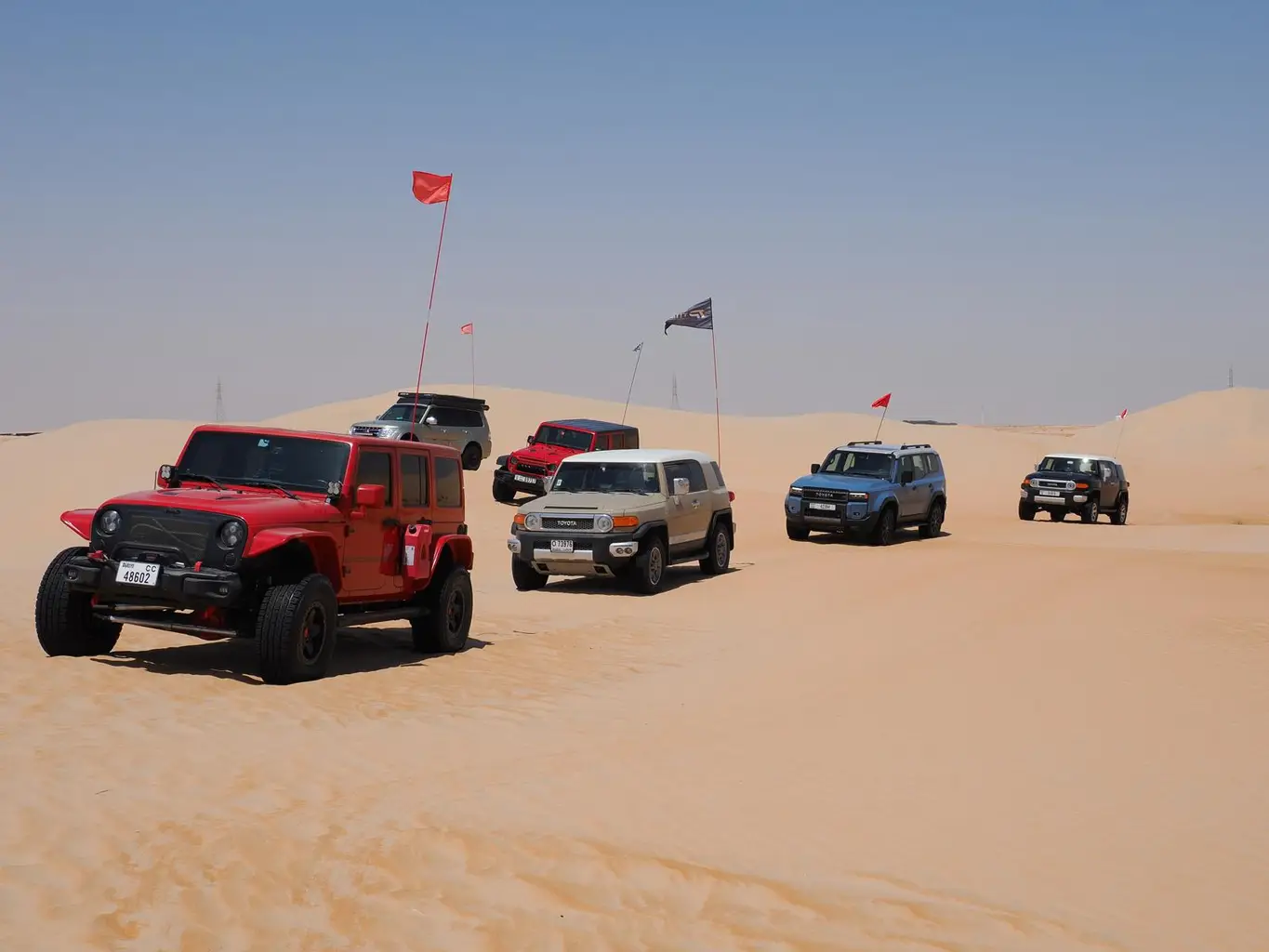
A convoy can look effortless from the outside: a line of capable 4x4s crossing open sand, climbing a rocky wadi, or threading through a mountain pass. In reality, that confidence is built long before the first wheel turns. Off road convoy driving rules give every driver a shared operating system, especially when visibility drops, terrain changes quickly, or a vehicle loses momentum.
A convoy is not a race and it is not a collection of people driving the same direction. It is a team moving at the pace, skill level, and safety margin set by the terrain and the least experienced prepared driver. Safety Always Comes First. That standard applies whether you are joining your first guided desert drive or preparing for a multi-day expedition across remote ground.
Off Road Convoy Driving Rules Start Before Departure
The first rule is simple: arrive ready. A delayed briefing, an underinflated spare, or a missing recovery point can affect every vehicle behind you. Preparation protects the group’s time, keeps the lead team focused on the route, and reduces the chance that a small issue becomes a recovery operation after dark.
Before joining the line, confirm that your vehicle is suitable for the planned route and that it has been checked for leaks, loose components, tire condition, fuel level, and battery health. Carry the equipment required by the organizer and know where it is stored. There is little value in owning a recovery strap, compressor, fire extinguisher, or first-aid kit if you cannot reach it quickly or use it correctly.
A proper briefing matters just as much as vehicle preparation. Listen for the route plan, drive level, radio channel, lead and sweep vehicle identification, regroup points, emergency procedure, and any terrain-specific warnings. Ask questions before departure, not while a line of vehicles waits on a dune face.
Know Your Place in the Line
Every convoy has a purpose-built order. The lead driver reads the terrain, chooses the route, and controls the pace. The sweep vehicle stays at the rear, confirms no one has been left behind, and communicates issues moving forward. Marshals or support vehicles may be positioned where they can assist newer drivers or respond quickly to recoveries.
Keep your assigned position unless a marshal directs otherwise. Changing places casually can separate friends from their planned support, confuse radio calls, and leave the sweep driver searching for a vehicle that is no longer where it should be. If you need to stop, have a vehicle concern, or feel out of your depth, communicate early.
The most useful habit is to maintain visual contact with the vehicle behind you whenever terrain allows. You are not responsible for leading their drive, but you are part of the information chain. If the vehicle behind disappears from view for longer than the terrain reasonably explains, notify the convoy. Do not assume someone else has seen the problem.
Spacing Is a Safety Tool, Not a Suggestion
Following too closely is one of the fastest ways to turn a routine drive into a chain reaction. In sand, the vehicle ahead may lose momentum, crest a ridge and stop, or change direction to avoid a soft patch. On mountain trails, it may pause for an obstacle, a tight turn, or oncoming traffic. Space gives you time to read the ground and make your own controlled decision.
The correct gap depends on terrain, speed, visibility, and convoy direction. On open, firm terrain, the distance may be greater to reduce dust and allow clear sightlines. On technical climbs or narrow trails, it may be shorter, but never so short that you cannot stop safely. Follow the lead team’s instructions rather than copying a fixed distance from a social media clip.
Avoid driving in the exact tracks of the vehicle ahead when conditions make that unsafe. In soft sand, those tracks can become deeper and less stable. At the same time, do not wander wide simply to create your own line. A wider line can expose you to hidden drops, vegetation, unstable edges, or a route the lead has deliberately avoided.
Communicate Clearly and Keep Radio Traffic Useful
A radio is a safety device, not background entertainment. Keep transmissions brief, calm, and relevant. State your convoy position or call sign, then describe the issue: “Vehicle seven, stopping with a temperature warning,” is far more useful than a vague request for help.
Listen before transmitting. The lead or marshal may be giving an instruction that affects the entire convoy. If you miss a call, ask for it to be repeated rather than guessing. Hand signals can support communication at close range, but they should not replace the agreed radio procedure when vehicles are separated by dunes, dust, bends, or elevation.
Good convoy communication also means reporting honestly. If you are uncomfortable with a slope, losing confidence in your vehicle, or noticing an unfamiliar mechanical sound, say so early. That is sound judgment, not weakness. Mutual Respect Is Non-Negotiable, and a well-run group responds to timely information without ridicule.
Drive the Terrain, Not the Vehicle Ahead
Convoy discipline does not mean blind imitation. The vehicle in front may have a different wheelbase, tire setup, clearance, traction system, or driver experience. Watch its line, understand the route, then drive your own vehicle within your capability.
This matters most on dunes. Maintain enough momentum to cross soft ground, but do not chase the vehicle ahead at a speed you cannot control. Crest carefully, because the far side may be steep, rutted, or occupied by another vehicle. If you lose momentum, avoid spinning the tires deeper. Stop, communicate your position, and wait for instruction unless there is an immediate safety concern.
On rocky trails, slow inputs and accurate wheel placement matter more than speed. Keep your thumbs outside the steering wheel spokes, use low range when appropriate, and allow spotters to guide you through obstacles. A spotter’s instruction is only useful if you can hear it, understand it, and respond gradually. Sudden steering, acceleration, or braking can put people and vehicles at risk.
Stop Safely and Never Self-Recover in a Hurry
When the convoy stops, do not brake abruptly without reason. Reduce speed progressively and leave room for the vehicles behind to settle into position. Do not stop on a blind crest, in a narrow pinch point, or directly below a steep slope unless the situation demands it.
If you are stuck, damaged, or unsure, communicate first. Recovery work has consequences: a poorly attached strap, incorrect recovery point, or a driver standing too close to a loaded line can cause serious injury. Only trained people should direct a recovery, and everyone not involved should remain at a safe distance.
The same principle applies to turnarounds and route changes. Do not make your own U-turn because you think you missed the group. Stop in a safe place, call the lead or sweep, and wait. Separation becomes much harder to solve when a driver keeps moving on an assumption.
Respect the Route, the Land, and the Community
Responsible off-roading leaves room for the next group, the local community, and the natural environment. Stay on approved routes where required, avoid damaging vegetation, do not disturb wildlife, and take every item you brought with you back out. A remote landscape is not an empty place. It is an environment with people, animals, access rules, and consequences.
Convoy etiquette extends beyond the trail. Be courteous at meeting points, fuel stops, camps, and public roads. Give other road users room. Keep noise, speed, and vehicle behavior appropriate for the location. The reputation of organized off-roading is built one interaction at a time.
Dubai Offroaders treats progression as earned: learn the fundamentals, build judgment through supervised experience, then take on more demanding terrain with the skills to support your team. A capable driver is not defined by the steepest dune they attempt. They are defined by how reliably they prepare, communicate, recover, and look after the people around them.
A Quick Pre-Drive Discipline Check
Before the convoy moves, every driver should be able to answer four questions: Is my vehicle ready for this route? Do I know the radio procedure and my convoy position? Can I see and respond safely to the vehicle behind me? Do I know what to do if I am stuck, separated, or concerned?
If any answer is no, pause and ask. The desert, the mountains, and the long tracks beyond the pavement reward calm decisions. Bring that discipline to every departure, and the convoy becomes more than a line of 4x4s - it becomes a team that can go farther with confidence and return together.
Remember: Lower tyre pressures to 15–18 PSI before touching sand to expand your longitudinal footprint. Never attach a snatch strap to a tow ball or bumper, and always keep both thumbs on the outside of the steering wheel rim.
Community Discussion0
Open public discussion. Share your thoughts, ask questions, or connect with certified marshals and fellow drivers.



No comments yet — be the first to break the desert silence!