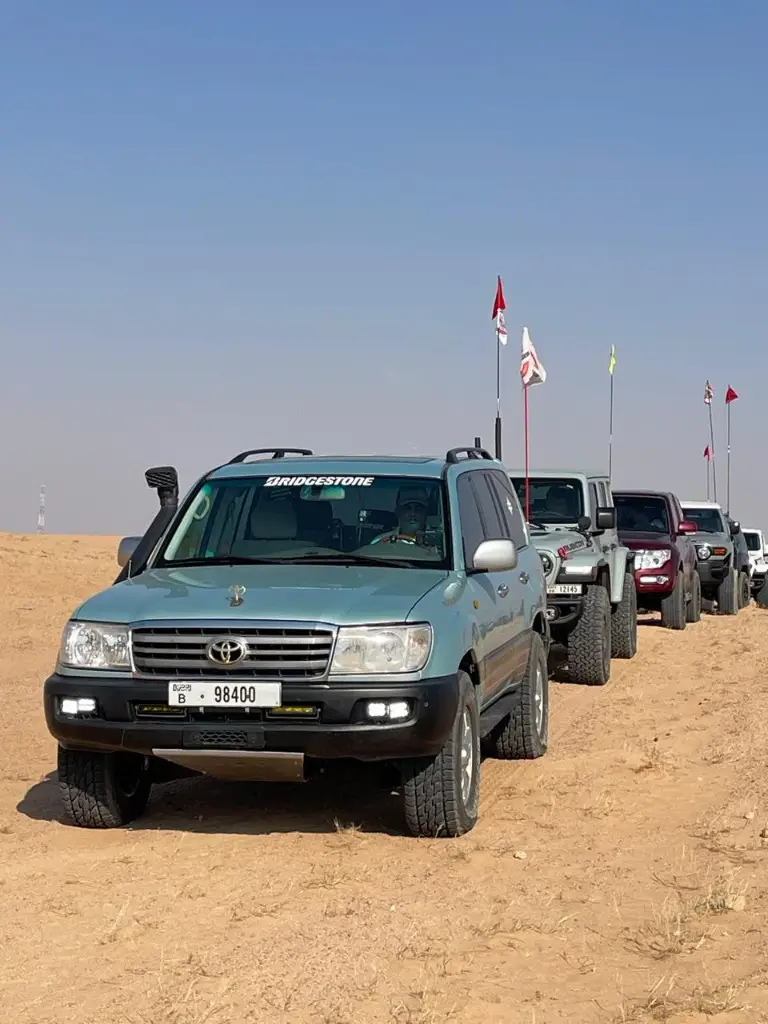
Key Takeaways & Field SummaryOfficial Marshal Notes
Off road marshal training builds the judgment, recovery skills, and convoy discipline needed to lead desert and mountain drives responsibly in the Gulf.
A convoy can look effortless from the driver’s seat: a line of 4x4s moving cleanly across a dune field, radios calm, every vehicle arriving together. What makes that possible is not luck or a powerful vehicle. It is leadership. Off road marshal training develops the practical judgment, communication, recovery awareness, and discipline required to protect the group when the route stops being predictable.
A marshal is not simply the most experienced driver in the convoy. They are the person who reads the terrain ahead, manages the pace behind, recognizes when a driver is reaching their limit, and makes conservative decisions before a small problem becomes a serious incident. In the desert, mountains, or a remote cross-border route, that responsibility must be earned.
What Off Road Marshal Training Really Prepares You For
Marshal training is the point where off-road ability becomes operational responsibility. You may already be comfortable driving sand, choosing lines, managing tire pressures, and recovering a stuck vehicle. Those are essential foundations. A marshal must apply those skills while monitoring several vehicles, changing terrain, weather, fuel range, radio traffic, and the wellbeing of every person in the convoy.
The role demands a wider field of view. A lead driver may focus on finding the safest, most enjoyable route. A marshal considers whether the third vehicle has clearance, whether the tail has received the instruction, whether a difficult crest needs spotting, and whether the group still has enough daylight to complete the route with margin.
That is why good training does not treat leadership as a badge. It treats it as a system of preparation, observation, and accountability.
The difference between driving well and leading well
A technically capable driver can climb a steep dune or navigate a rocky ascent. A capable marshal knows when not to ask a convoy to do either. They can identify the difference between productive challenge and unnecessary exposure.
This distinction matters most when conditions change. Wind can reshape a familiar dune line overnight. Rain can alter a mountain wadi and create unstable approaches. A recovery that is straightforward with two prepared vehicles can become complex if drivers crowd the scene or use equipment without direction. A marshal brings order to those moments.
The Core Skills a Marshal Must Build
The strongest marshal programs combine classroom understanding with supervised field practice. Knowledge must be tested where it matters: under pressure, with real vehicles, real terrain, and a clear safety structure.
Convoy formation, control, and communication
Every organized drive needs a plan before the wheels move. Marshals learn to assess vehicles and drivers, establish a suitable convoy order, confirm radio procedures, and explain the route, expected conditions, and behavior standards at the briefing.
Clear communication is one of the most valuable skills on the trail. Instructions should be brief, accurate, and understood by the whole group. A marshal must know how to issue route calls, warn of hazards, coordinate a stop, manage separation, and confirm that the tail vehicle is accounted for.
There is a trade-off here. Too much radio traffic creates confusion. Too little leaves drivers guessing. The right standard is purposeful communication: say what the convoy needs to know, when it needs to know it.
Terrain reading and route decisions
Desert and mountain leadership requires constant route assessment. In sand, a marshal evaluates slope angle, crest shape, runout area, side-slope exposure, traffic flow, and the consequences of a refusal. In mountain terrain, they add loose rock, ground clearance, wheel placement, washouts, narrow passages, and the risk of meeting another vehicle where there is no easy turn-around.
A route should match the least prepared driver and vehicle in the group, not the marshal’s personal capability. That does not mean every drive must be easy. It means challenge must be deliberate, communicated, and supported by realistic alternatives.
Strong marshals also preserve options. Before entering a technical section, they consider exit routes, recovery anchor points, vehicle positioning, and what happens if weather or mechanical trouble forces a change of plan.
Recovery leadership, not just recovery technique
Recovery is one of the areas where confidence can become dangerous. Knowing how to use a kinetic rope, soft shackle, shovel, traction boards, winch, or rated recovery point is only the beginning. A marshal must control the entire recovery scene.
That means stopping unnecessary movement, keeping bystanders outside the danger zone, inspecting attachment points, choosing the least aggressive effective method, assigning clear roles, and communicating before tension is applied. The goal is never to perform a dramatic recovery. The goal is to return the vehicle to safe travel without creating another hazard.
Recovery choices depend on terrain, vehicle position, equipment, and the driver’s condition. Sometimes the safest call is a simple shovel-and-air-down correction. Sometimes it is a controlled tow. Sometimes the responsible choice is to stop, reassess, and bring in additional support. Good judgment is knowing that speed is not the only measure of success.
People management under pressure
Off-roading is a team activity, even when every participant drives their own vehicle. A marshal needs the confidence to give clear direction and the humility to listen when another experienced team member sees a risk.
They also need to recognize human factors. A new driver may be embarrassed after repeated refusals. An experienced driver may push beyond the agreed pace. Fatigue, heat, low visibility, family passengers, and a mechanical concern can all affect decision-making. Mutual respect is non-negotiable, but so is intervention when safety requires it.
A good marshal never uses authority to create fear. They create trust by being calm, consistent, prepared, and fair.
How Marshal Qualification Should Be Earned
No responsible organization should rush drivers into leadership after one advanced drive. Marshal readiness is built through a progression of capabilities: competent vehicle preparation, confident terrain driving, recovery training, navigation awareness, convoy participation, and supervised leadership experience.
At Dubai Offroaders, the purpose of progression is not to make the journey feel exclusive. It is to ensure that each driver receives the right challenge at the right time. A future marshal benefits from spending time in different convoy positions, observing how experienced leaders handle a route change, and learning to support a recovery without immediately taking command.
Assessment should be ongoing rather than based only on a final test. Instructors and senior marshals can observe how a candidate prepares, communicates, accepts feedback, makes decisions, and treats other drivers. Technical skill matters, but judgment and character matter just as much.
Training scenarios that reveal real readiness
The most useful exercises place candidates in realistic, controlled situations. They may be asked to brief a convoy, choose a safe line through a technical area, coordinate a simulated vehicle refusal, manage a communications issue, or revise a route after a changing condition.
These scenarios reveal habits that are easy to miss in casual driving. Does the candidate check that the tail is present? Do they protect the recovery zone? Do they explain the reason behind a decision? Can they slow the group down without losing control of the atmosphere?
The answer does not need to be perfect on the first attempt. Training exists to build that capability. What matters is a willingness to learn, follow procedure, and improve after direct feedback.
Standards That Protect the Adventure
Marshal training is not separate from the culture of responsible off-roading. It is where that culture becomes visible. The convoy’s behavior around wildlife, tracks, campsites, local communities, and fellow trail users is shaped by its leaders.
A marshal sets the tone by avoiding unnecessary damage to the environment, respecting access restrictions, keeping the convoy organized, and ensuring no participant is left behind. They model preparation: suitable equipment, enough water, reliable communications, vehicle checks, and a route plan that respects daylight and distance.
They also understand that turning back can be a leadership decision, not a failure. A route may be abandoned because of deteriorating weather, a mechanical issue, a driver who needs support, or a recovery risk that no longer fits the available resources. The desert will still be there. The priority is that everyone returns safely.
Is Marshal Training Right for You?
Marshal training is right for drivers who enjoy taking responsibility for more than their own vehicle. You do not need to be the loudest person in the group or the driver with the most aggressive setup. You do need patience, sound judgment, technical curiosity, and respect for procedures.
If you are still building basic sand-driving confidence, begin there. Learn your vehicle, practice recoveries under instruction, and become a dependable convoy member. If you are already advanced, marshal training can give your experience structure and turn instinct into repeatable leadership.
The next time you watch a well-run convoy disappear over a ridge, look beyond the tracks. Notice the spacing, the radio discipline, the measured pace, and the way every vehicle is accounted for. That is the standard worth training for: adventure with purpose, challenge with control, and leadership that brings everyone home.
Remember: Lower tyre pressures to 15–18 PSI before touching sand to expand your longitudinal footprint. Never attach a snatch strap to a tow ball or bumper, and always keep both thumbs on the outside of the steering wheel rim.
Community Discussion0
Open public discussion. Share your thoughts, ask questions, or connect with certified marshals and fellow drivers.

No comments yet — be the first to break the desert silence!