Key Takeaways & Field SummaryOfficial Marshal Notes
Learn how tire deflators deliver safer, more capable desert traction, and choose the right range, accuracy, and speed for every UAE drive off-road.
A desert drive can change character in one soft climb. Your 4x4 may have the power, clearance, and correct line, yet still sink because its tires are carrying road pressure. Tire deflators are the small, practical tools that help convert a road-ready vehicle into one that can float, steer, and recover traction in sand. Used correctly, they are not a shortcut around skill. They are part of disciplined vehicle preparation.
For Gulf off-roaders, air pressure is a decision made before the convoy moves, not an adjustment made after the vehicle is already buried. The right pressure improves the tire’s footprint and lets it conform to soft terrain. The wrong pressure can leave you struggling for momentum, fighting the steering wheel, or risking tire damage. Safety Always Comes First, and that begins at the tire valve.
What Tire Deflators Actually Do
Tire deflators release air from a tire in a controlled way. Their purpose is simple: reach a lower, suitable off-road pressure quickly and consistently. By reducing pressure, the tire spreads across more surface area. On soft sand, that larger footprint helps the vehicle float rather than cut down through the surface.
This matters most when a convoy enters technical dunes, powdery bowls, churned-up tracks, or long soft climbs. A vehicle at highway pressure may feel sharp and efficient on pavement, but in sand it can behave like it is wearing narrow shoes in deep snow. Lowering pressure gives the tire more working area and more grip.
Deflation also changes how the vehicle rides and responds. The sidewall flexes more, which can soften the impact of small ridges and help the tire maintain contact over uneven terrain. That does not mean lower is always better. Excessive deflation can increase the chance of a tire unseating from the wheel, especially during hard steering inputs, side slopes, or aggressive turns.
Why a Gauge Matters as Much as the Deflator
A deflator without a trustworthy gauge is only a fast way to guess. Desert driving requires repeatability. If your instructor or trip leader calls for a specific pressure, every vehicle in the convoy should be close to that target, with adjustments made for tire type, vehicle weight, terrain, and the demands of the route.
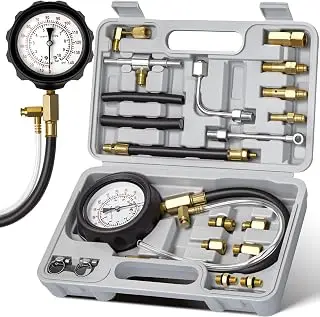
The best tire deflators combine a valve-core tool, controlled airflow, and an integrated gauge. Many designs remove the valve core temporarily, allowing air to escape rapidly, then let you close the valve and read the pressure without removing the tool. Others use a simple push-button release connected to a gauge. Both can work well when the gauge is accurate and the user knows how to operate it.
Analog gauges are popular because they are straightforward, durable, and easy to read in bright desert light. Digital gauges can offer finer readings, but they depend on batteries and should be protected from heat, sand, and impact. For a serious off-road kit, a separate quality pressure gauge is still worth carrying as a cross-check. Equipment fails at inconvenient moments. Prepared drivers build redundancy into the essentials.
Choosing Tire Deflators for Your Vehicle
There is no universal pressure setting and no single deflator that suits every driver. A lightweight SUV on moderate sand, a heavily loaded overland vehicle, and a short-wheelbase 4x4 on technical dunes may require different approaches. Start by choosing equipment that supports control rather than speed alone.
Adjustable Deflators
Preset or automatic tire deflators are designed to stop releasing air once a chosen pressure is reached. They are useful for drivers who want all four tires brought down at the same time. Set the target, attach one to each tire, and complete a walk-around while they work.
Their advantage is consistency and convenience. Their limitation is that preset mechanisms should be checked regularly. Sand, damage, and wear can affect performance, and a setting that was correct for one drive may not suit the next. Always verify the final pressure with a gauge before joining the convoy.
Manual Deflators With Built-In Gauges
A manual deflator is slower because you work one tire at a time, but it gives direct control over the process. This style is ideal for drivers who are learning what pressure changes feel like and who want to monitor each tire closely.
Look for a flexible hose, a protected gauge, a valve-core tool that operates smoothly, and a case that keeps dust out of the fittings. In the desert, simple equipment that is easy to inspect often earns its place over complex equipment with more failure points.
Basic Valve Tools
A small valve tool or even a key-style deflator can release air, but it is the least controlled option. It may be acceptable as an emergency backup, not as your primary solution for organized off-roading. Releasing air without measuring pressure invites inconsistency across the vehicle and across the convoy.
Set Pressure for the Terrain, Not for Ego
New drivers sometimes treat low pressure as a badge of confidence. It is not. Pressure should match conditions and be selected with care. Your vehicle’s tire construction, wheel size, load, suspension setup, driving style, and the route’s technical level all influence the correct choice.
On a managed desert drive, follow the pressure guidance given at the meeting point. It reflects local terrain, current conditions, and the group’s planned pace. If you are carrying extra expedition equipment, towing, running unusually stiff sidewalls, or have a vehicle-specific concern, speak up before departure. Good convoy leaders would rather make a considered adjustment at the start than manage a preventable recovery later.
Pressure also needs reassessment. Morning sand can be firm after a cool night, then become loose and punishing as temperatures rise and traffic cuts up the route. A driver who cannot maintain momentum in consistently soft terrain may need a measured pressure change, better line choice, smoother throttle, or all three. Do not make a dramatic adjustment alone and disappear into the next dune. Communicate with the convoy.
The Deflation Routine Before Every Drive
A calm, repeatable routine protects the vehicle and keeps the group moving. Park on stable ground with enough room to work safely. Set the parking brake, inspect each tire for cuts, nails, sidewall damage, and visible bulges, then remove valve caps and keep them together in a clean pocket or container.
Attach the tire deflator securely and release air in a controlled manner. Check pressure after each tire, working toward the target set by the trip leader. Once all four tires are complete, replace valve caps firmly. Take a final walk-around for anything loose, leaking, or left behind.
Do not rush because the rest of the convoy is waiting. Organized off-roading depends on each driver arriving at the start line properly prepared. A few deliberate minutes at the deflation area are faster than a recovery, a damaged tire, or a delay deep in the route.
Avoid the Mistakes That Damage Tires
The most common mistake is forgetting that deflation is only half the process. Tires must be reinflated before returning to pavement. Low-pressure tires generate excess heat and handle poorly at road speeds. Carry an air compressor that can handle your tire size, a reliable gauge, and enough time at the exit point to restore safe road pressure.
Avoid sharp steering at low pressure, particularly when climbing out of ruts or crossing a side slope. Keep inputs smooth and preserve momentum rather than using sudden throttle. If you feel a tire has slipped on the wheel, stop safely, inform the convoy, and assess it. Continuing may turn a manageable issue into a full tire failure.
Also remember that tire pressure cannot compensate for poor preparation. A deflator belongs in a complete off-road kit alongside recovery points, a rated recovery rope or kinetic rope where appropriate, shackles, a shovel, communications equipment, water, and a compressor. More importantly, it belongs beside trained judgment.
A Small Tool That Builds Better Habits
Tire deflators are inexpensive compared with most off-road upgrades, but their value reaches far beyond convenience. They teach a core desert-driving principle: prepare before the terrain forces the decision. Every careful pressure check reinforces awareness of vehicle behavior, terrain conditions, and responsibility to the people traveling with you.
At Dubai Offroaders, we see confidence grow when drivers understand the reason behind each step, from airing down at the start to airing up before the road home. Choose tire deflators you can use accurately, practice with them before your next drive, and treat every valve cap you replace as a quiet signal that you are ready for what lies beyond the road.
Remember: Lower tyre pressures to 15–18 PSI before touching sand to expand your longitudinal footprint. Never attach a snatch strap to a tow ball or bumper, and always keep both thumbs on the outside of the steering wheel rim.
Community Discussion0
Open public discussion. Share your thoughts, ask questions, or connect with certified marshals and fellow drivers.


No comments yet — be the first to break the desert silence!