
Key Takeaways & Field SummaryOfficial Marshal Notes
Are desert drives safe? Learn how vehicle prep, convoy discipline, terrain reading, and trained recovery turn remote travel into responsible adventure.
A desert can look forgiving from the road: clean horizons, open sand, and a route that appears easy enough to follow. Then the surface changes, a crest hides a sharp drop, or a vehicle loses momentum in soft sand. So, are desert drives safe? They can be, but safety is never created by the desert itself or by the badge on a 4x4. It is created by preparation, training, discipline, and a team that makes good decisions before small problems become serious ones.
For drivers across the UAE, Oman, and Saudi Arabia, desert driving is not simply a scenic escape. It is a technical activity in a remote environment where heat, distance, changing terrain, and limited phone coverage can compound quickly. The reward is real: wide open landscapes, demanding dunes, and the confidence that comes from traveling capably beyond the pavement. But the right question is not whether the desert is dangerous. The right question is whether you and your group are prepared for the conditions ahead.
Are Desert Drives Safe for First-Time Drivers?
A first desert drive can be safe when the route, pace, vehicle, and supervision match the driver's ability. It is not safe to treat social media clips or a friend’s casual invitation as training. Dune driving asks you to manage momentum, tire pressure, steering inputs, approach angles, sight lines, and spacing while reading sand that can change from one ridge to the next.
Beginners benefit most from an organized, skill-level-appropriate convoy led by experienced drivers. A good leader does more than point toward the next dune. They set the pace, explain expectations, watch for fatigue, manage stops, and choose terrain that builds competence without overwhelming people. That structure gives a new driver room to learn without being isolated or pushed to perform.
The vehicle matters, but it is not the whole answer. A capable 4x4 in low range is a sound starting point for many routes, yet ground clearance and horsepower do not replace judgment. An aggressive driver in a well-equipped vehicle can create more risk than a patient, trained driver in a modest but properly prepared 4x4.
What Makes a Desert Drive Safer?
Safe desert travel begins long before tires touch sand. It starts with an honest assessment of the vehicle, the route, the weather, and the people joining the drive. There is no single checklist that eliminates risk, but four disciplines consistently make the difference.
1. Vehicle preparation is non-negotiable
A desert vehicle should be mechanically sound, fueled appropriately, and equipped for the planned terrain. Tires need adequate tread and must be adjusted to a suitable pressure for the conditions. Drivers should carry a functioning spare, air compressor, pressure gauge, rated recovery points, a recovery rope or kinetic rope suited to the vehicle, shackles where appropriate, a shovel, and basic first-aid and communication equipment.
Equipment only helps when drivers know how to use it. A recovery rope attached to the wrong point can damage a vehicle or injure someone nearby. A shovel is valuable when used early and methodically, not after frantic wheelspin has buried the vehicle to its chassis. Recovery training turns gear from a collection of accessories into a practical safety system.
2. Terrain reading protects the convoy
Desert driving is a constant exercise in observation. Sand color and texture can indicate firmness. Windward and leeward dune faces behave differently. A smooth ridge can conceal a steep slipface, and tracks ahead may tell you little about what the next vehicle can handle.
Drivers must learn to approach crests carefully, avoid blind launches, and respect the limits of their line. Side-sloping is another area where calm technique matters. Steering, throttle, and vehicle position must be deliberate. If the angle does not feel right, the disciplined choice is to stop, reassess, and select another route. Turning back is not failure. It is sound off-road judgment.
3. Convoy discipline prevents avoidable incidents
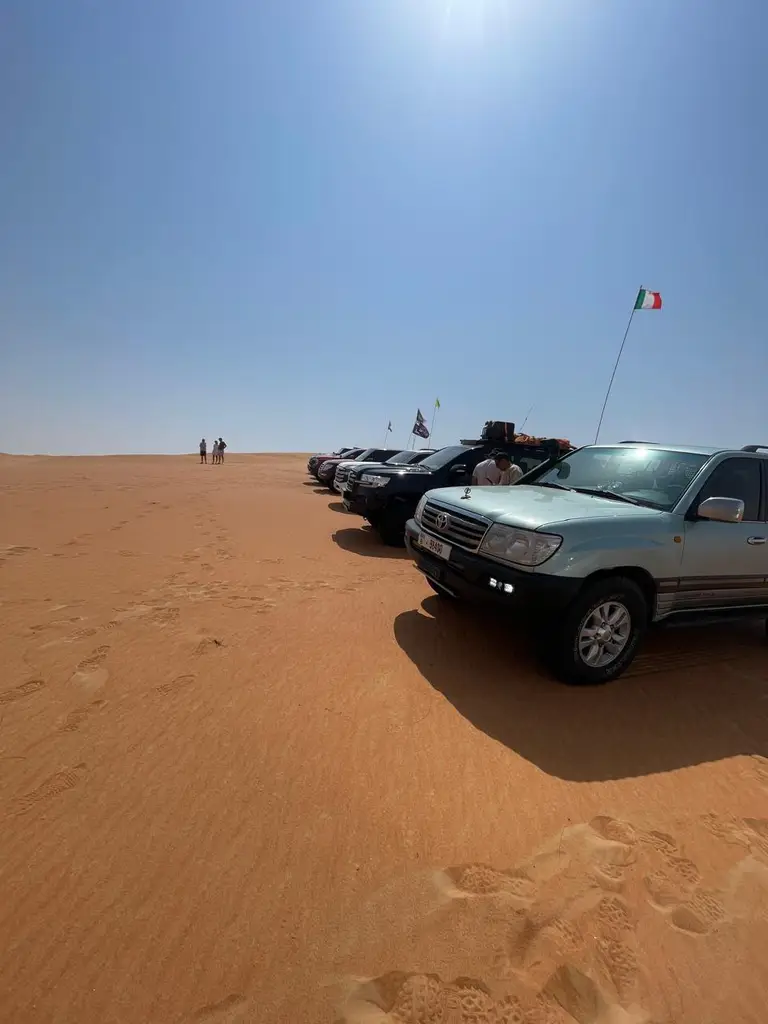
A desert convoy is a team, not a line of independent vehicles chasing the same view. Each driver has a responsibility to maintain safe spacing, follow radio instructions, keep the vehicle behind in sight when required, and communicate immediately when something is wrong.
Spacing deserves particular attention. Too close, and a follower has no room if the lead vehicle slows, crests unexpectedly, or becomes stuck. Too far apart, and visual contact or radio clarity can be lost. The correct gap changes with speed, dune size, visibility, and the experience of the group. A leader who adjusts the pace and formation to conditions is managing risk, not reducing the adventure.
Mutual support also means no one is left behind. If a vehicle is delayed, the convoy responds as a unit under the leader’s direction. That culture protects people, vehicles, and the quality of the entire day.
4. Weather, heat, and timing shape every decision
The desert does not need a dramatic storm to become challenging. High temperatures can drain concentration, increase the chance of dehydration, and stress engines and tires. Strong winds can erase tracks and reduce visibility. Rain can transform access roads, harden or destabilize sand, and create hazards in wadis and low-lying areas.
A responsible plan considers the season and starts early enough to avoid unnecessary exposure to midday heat. Every vehicle should carry more drinking water than the driver expects to use, along with food, sun protection, and clothing appropriate for both heat and cooler evenings. In remote areas, extra fuel and a clear turnaround point are part of the plan, not signs of pessimism.
The Biggest Mistakes to Avoid
Most desert incidents are not caused by one dramatic error. They grow from several smaller choices: skipping a vehicle check, following an unfamiliar route after dark, driving beyond skill level, or assuming another vehicle will have the recovery gear you forgot.
Speed is often misunderstood. Momentum is useful in soft sand, but uncontrolled speed is not skill. The objective is to carry enough momentum for the terrain while retaining time and space to respond. Fast driving can be appropriate only when the route, visibility, vehicle control, and group standard support it.
Another common mistake is continuing after fatigue sets in. Sand driving demands concentration in a way highway driving does not. If you are tense, overheated, distracted, or no longer processing instructions clearly, say so. A short stop, a change of route, or an early exit is a responsible decision.
Finally, never treat recovery as entertainment. Spectators should stay clear, the recovery area should be controlled, and every attachment point and line should be checked before force is applied. The goal is a clean, low-risk extraction, not a dramatic pull for the camera.
Training Changes What You See
The most valuable off-road skill is not a particular maneuver. It is the ability to assess a situation early and choose the least risky solution. Formal training develops that mindset through controlled practice: tire deflation, basic sand techniques, crest management, side-slope awareness, radio procedure, stuck assessment, and recovery fundamentals.
With experience, drivers begin to see the desert differently. They notice where a line will lose momentum, where a convoy needs more distance, and when a dune should be approached from another angle. They also learn the confidence to decline a route that is outside their capability. That is what progression should produce: not bravado, but better decisions.
At Dubai Offroaders, this progression is built around guided drives, practical training, and a clear respect for convoy standards. Whether your goal is a first confident drive on manageable sand or a demanding expedition route, the principle stays the same: Safety Always Comes First.
A Better Standard for Desert Adventure
Desert drives are safest when adventure and responsibility travel together. Go with people who plan properly, choose routes honestly, communicate clearly, and respect both the land and every person in the convoy. Bring the right equipment, but bring the right attitude too: stay humble, listen to instruction, and speak up early when conditions change.
The desert rewards prepared drivers with more than a good day out. It teaches composure, teamwork, and the quiet confidence of knowing that when the terrain asks more of you, you are ready to answer responsibly.
Remember: Lower tyre pressures to 15–18 PSI before touching sand to expand your longitudinal footprint. Never attach a snatch strap to a tow ball or bumper, and always keep both thumbs on the outside of the steering wheel rim.
Community Discussion0
Open public discussion. Share your thoughts, ask questions, or connect with certified marshals and fellow drivers.

No comments yet — be the first to break the desert silence!