Key Takeaways & Field SummaryOfficial Marshal Notes
Responsible off road driving protects people, vehicles, and fragile terrain. Learn the habits that make every desert and mountain drive safer for all.
A desert track can disappear beneath the next windstorm. A mountain trail can change after one night of rain. That is why responsible off road driving is not a set of rules you remember when something goes wrong. It is the discipline you bring before the engine starts, at every crest, and when the convoy needs to make a difficult decision.
The best drivers are not defined by how aggressively they attack a dune or how quickly they complete a route. They are known for sound judgment, calm communication, mechanical sympathy, and the willingness to turn back when conditions demand it. Adventure is earned through preparation. Safety Always Comes First.
Responsible Off Road Driving Begins With Readiness
Off-road capability is a combination of driver skill, vehicle condition, recovery knowledge, and teamwork. A capable 4x4 with an unprepared driver is not a capable off-road vehicle. Before leaving pavement, know the route, terrain, weather outlook, meeting point, fuel range, and expected finish time. Tell someone outside the group where you are going, particularly for remote routes or overnight trips.
Vehicle preparation should match the drive, not your confidence level. Check tire condition, fluid levels, battery health, cooling system, recovery points, spare tire, and all lights. In desert terrain, drivers must understand how and when to adjust tire pressure, then reinflate before returning to highway speeds. In mountain terrain, brakes, suspension, underbody protection, and tire sidewalls deserve even closer attention.
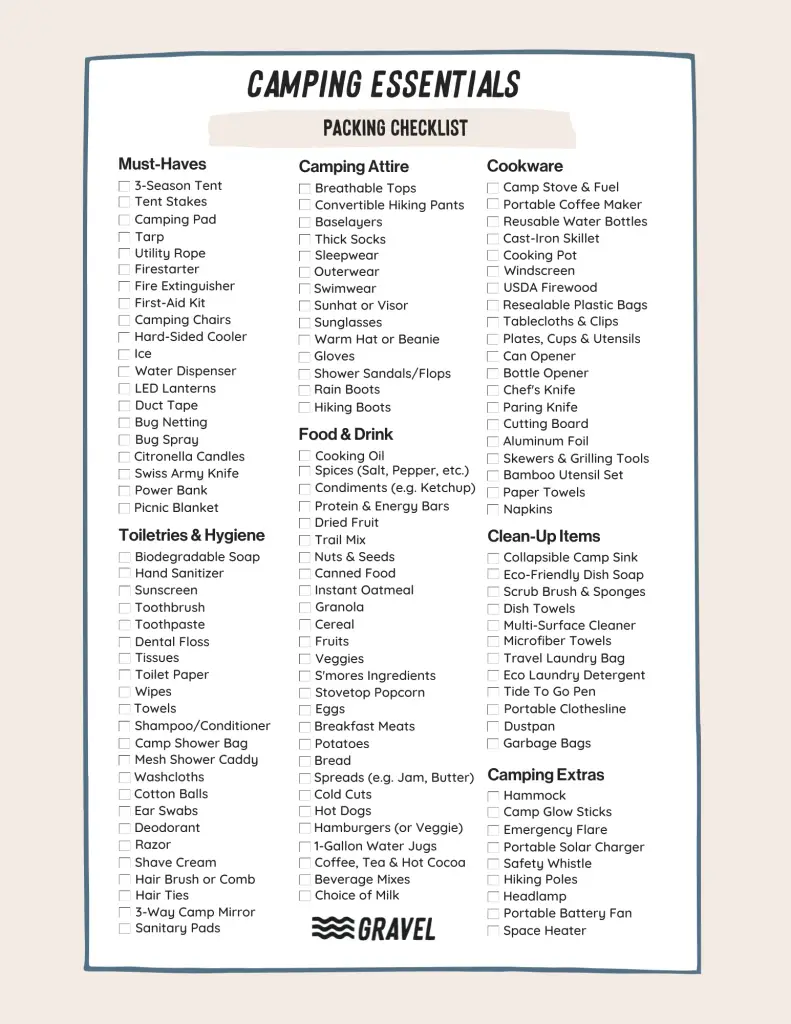
Carry recovery equipment that is rated for the job and that you know how to use. A shovel, recovery boards, kinetic rope, soft shackles, tire gauge, compressor, fire extinguisher, first-aid kit, navigation backup, water, and communications equipment are not decorative accessories. They are part of the plan. Equipment without training can create a second emergency, especially when stored energy is involved in a recovery.
Drive Within the Limits of the Terrain
Every surface asks something different of the vehicle and driver. Sand rewards momentum, smooth inputs, and careful observation of the terrain ahead. Rocky trails require controlled wheel placement, patient throttle application, and protection of the vehicle's underbody. Mud, gravel, wadis, and narrow mountain tracks each introduce their own consequences for braking, traction, visibility, and recovery.
The right pace is not the fastest pace. It is the speed that gives you time to read the surface, maintain safe spacing, and respond to the unexpected. Never follow the vehicle ahead so closely that you lose the ability to stop or choose another line. On dunes, this distance is essential. A vehicle may lose momentum, crest slowly, or require an immediate change of direction beyond your line of sight.
Crests deserve special discipline. Reduce speed before the top, approach at the correct angle, and never launch into terrain you cannot see. The far side may hold a sharp drop, another vehicle, soft sand, wildlife, or a change in slope that demands a controlled descent. A few seconds of restraint can prevent a serious rollover.
Convoy discipline is a safety system
An organized convoy works because every driver understands their role. Keep the assigned order unless the lead team directs otherwise. Maintain radio awareness, acknowledge instructions clearly, and report trouble early. If you are stuck, damaged, uncertain about a line, or feeling fatigued, say so immediately. There is no value in pretending that everything is under control.
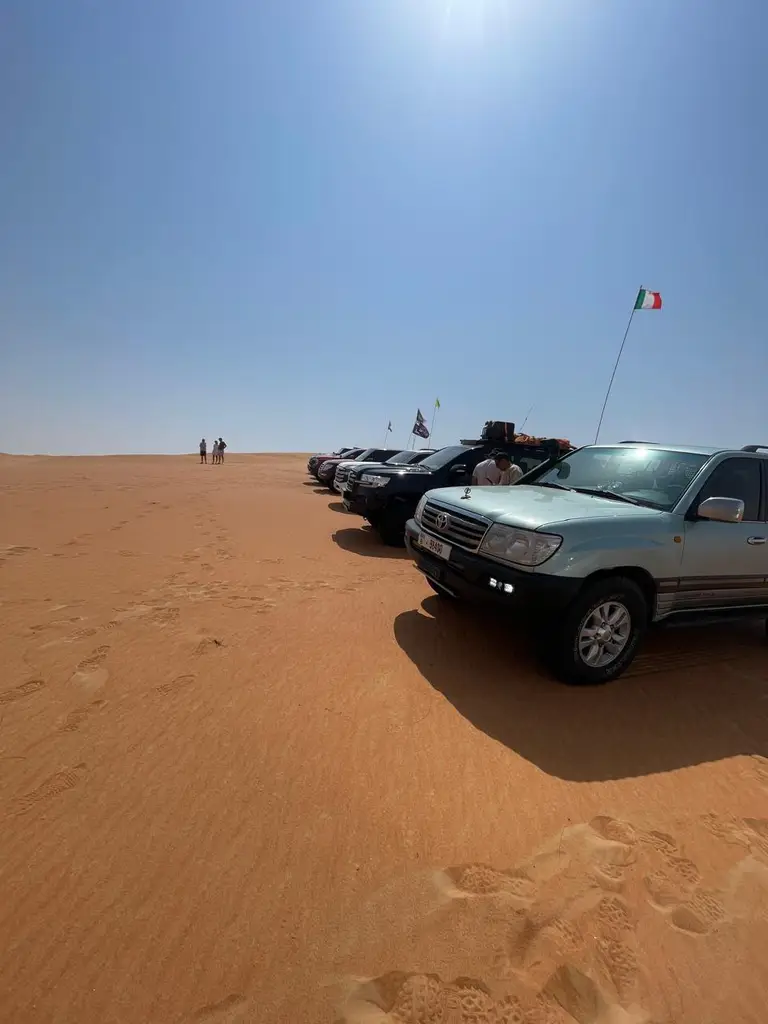
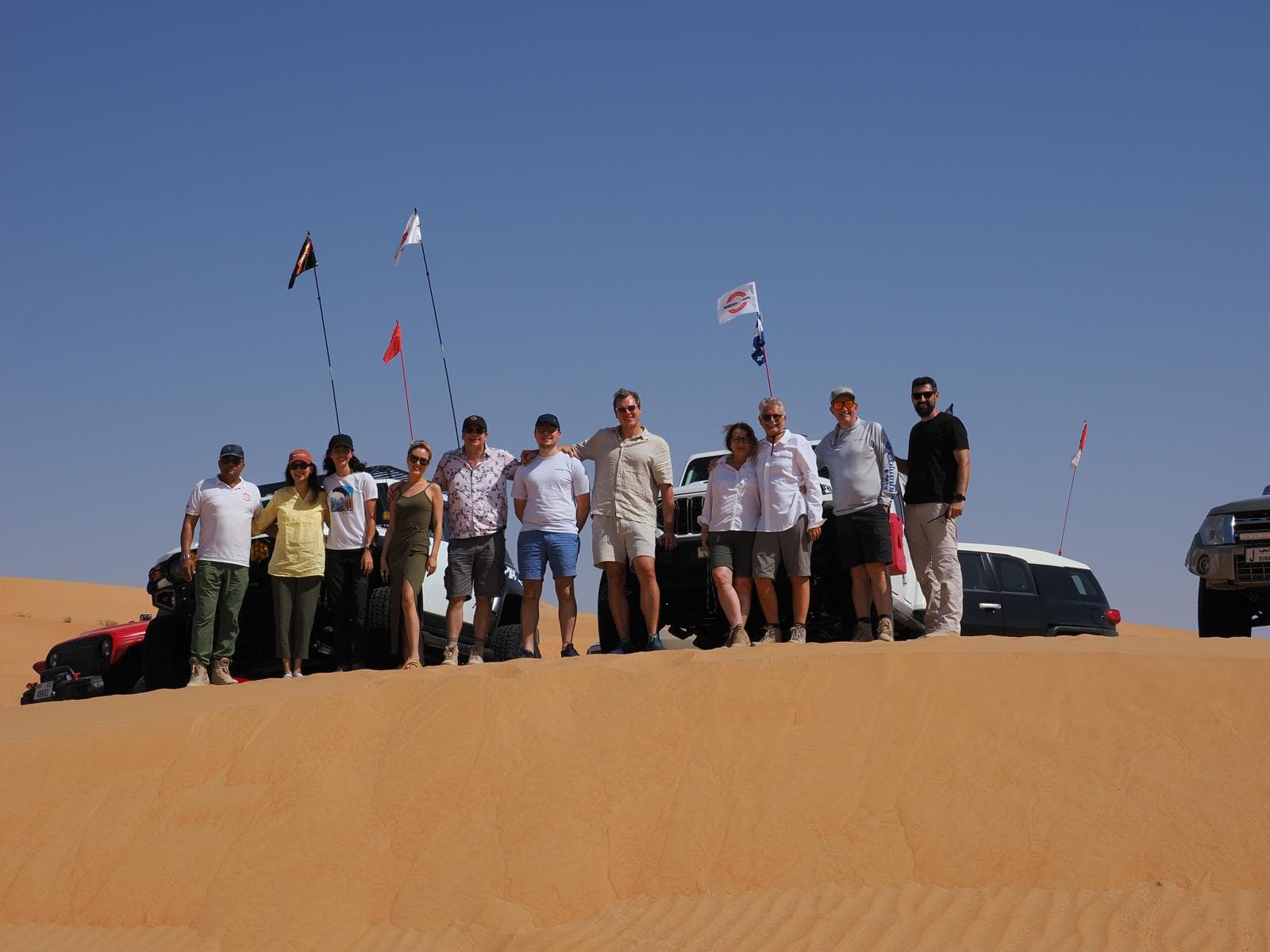
At Dubai Offroaders, convoy driving is treated as a shared responsibility, not a solo performance. The lead reads the route, the sweep monitors the group, and every driver protects the rhythm between them. Mutual support is not optional when a convoy is moving through remote terrain.
Do not overtake without instruction. Do not break away to attempt a separate dune line, shortcut, or photo stop. In open desert, what looks close can be separated by soft bowls, steep slipfaces, or terrain that blocks radio signals. In the mountains, an unplanned stop can obstruct a narrow trail or leave drivers exposed to falling rocks and blind corners.
Recover Deliberately, Not Dramatically
Getting stuck is part of off-road driving. Turning a simple stuck into an injury, broken bumper, or damaged chassis is not. The first response should be to stop, assess, and communicate. Repeated hard throttle often digs the vehicle deeper, overheats components, and sends sand or stones toward people nearby.
Before any recovery, establish a safe working area. Keep unnecessary people away from the line of pull. Inspect recovery points and equipment for damage, ensure the pulling vehicle has stable traction, and agree on a clear communication plan. Nobody should stand near a tensioned rope, strap, or shackle. A recovery should be calm, brief, and controlled, with everyone understanding what will happen before movement begins.
Sometimes the safest solution is not the quickest one. Digging around tires, lowering pressure within safe limits, using recovery boards, changing the pull angle, or bringing in a more experienced driver may take longer. It may also avoid damage that ends the drive for everyone.
Know when to stop
Responsible drivers recognize that conditions can exceed the plan. Rising temperatures, falling visibility, flash-flood risk, a mechanical warning, driver fatigue, or repeated recoveries are all reasons to reassess. Turning around is not failure. It is leadership.
This is especially true in mixed-skill groups. A route that feels straightforward to an advanced driver may overwhelm a newcomer who is still learning vehicle balance, throttle control, and radio procedure. Strong groups adapt their route and pace to the people present. Nobody should be pressured into terrain beyond their training or vehicle setup.
Respect the Land That Makes the Drive Possible
Deserts and mountain routes are not empty playgrounds. They are living environments, working landscapes, and places shared with wildlife, local communities, other travelers, and future generations of drivers. Responsible access depends on behavior that leaves as little trace as possible.
Stay on established tracks where required, avoid sensitive vegetation, and do not cut new lines simply for a fresh challenge. Keep distance from animals and never chase, surround, feed, or disturb them for a photograph. In wadis and mountain areas, respect private land, farms, villages, gates, and local traffic. Slow down near people, livestock, camps, and other vehicles.
Take out everything you bring in. That includes food waste, plastic, broken gear, cigarette waste, and vehicle parts. If your vehicle leaks fluids or leaves debris after a recovery, deal with it immediately. The standard is simple: leave the route better than you found it when possible.
Campfires require the same restraint. Use them only where permitted, keep them contained, and fully extinguish them before departure. In dry conditions, a single careless spark can threaten a much larger area than any group can manage alone.
Build Skill Before You Need It
No article can replace practical instruction. Sand driving, winching, route reading, emergency response, and convoy procedure are physical skills learned through guided repetition. Training gives drivers a controlled environment to make mistakes, ask questions, and understand why a technique works before the terrain becomes unforgiving.
Progress should be earned. Start with fundamentals: vehicle setup, radio use, tire pressure, safe following distance, smooth steering, and basic self-recovery. Move into more technical dunes, mountain routes, night driving, navigation, advanced recovery, and leadership only when the earlier habits are consistent. Confidence matters, but competence is what carries a group safely through a difficult route.
A responsible driver also keeps learning. Review a challenging drive afterward. What changed in the terrain? Was the convoy spacing right? Did communication stay clear? Was a recovery handled efficiently? Honest reflection turns experience into skill and helps every future passenger, teammate, and trail user.
The next time the dunes open ahead or a mountain trail disappears around the bend, let patience lead the way. The most memorable off-road days are not the ones where risks were ignored. They are the ones where a prepared group went farther, learned more, and returned together.
Remember: Lower tyre pressures to 15–18 PSI before touching sand to expand your longitudinal footprint. Never attach a snatch strap to a tow ball or bumper, and always keep both thumbs on the outside of the steering wheel rim.
Community Discussion0
Open public discussion. Share your thoughts, ask questions, or connect with certified marshals and fellow drivers.

No comments yet — be the first to break the desert silence!