Key Takeaways & Field SummaryOfficial Marshal Notes
Read our portable air compressor review for desert and trail driving: airflow, duty cycle, fittings, heat, and what keeps your 4x4 moving safely off-road.
A portable air compressor review matters most when your tires are hot, the sun is dropping, and the nearest pavement is still a long drive away. Airing down gives a 4x4 the footprint and compliance it needs in soft sand, loose climbs, and rough trails. Airing back up is what gets the vehicle safely home. This is not a convenience accessory. It is part of your recovery, vehicle-preparation, and convoy-readiness system.
For desert drivers, the right compressor is rarely the cheapest or the smallest unit that claims a high pressure number on its box. The real question is whether it can inflate four warm all-terrain or mud-terrain tires at a dependable pace, without overheating, leaking at the connection, draining the battery, or leaving you stranded at the edge of the blacktop.
Portable Air Compressor Review: What Matters Off-Road
A compressor should be judged by the job it must complete, not by showroom specifications alone. A compact unit may be fine for topping up a road car tire. A serious 4x4 needs enough airflow and thermal capacity to recover from a full air-down after a desert drive, potentially more than once in a day.
The most useful number is airflow, commonly shown as CFM, or cubic feet per minute. Higher CFM generally means faster inflation, but marketing figures can be misleading when they are measured with no resistance. Ask how a compressor performs at the pressure you actually use. A unit that advertises impressive free-flow volume but slows dramatically above 25 psi can turn a simple exit from the desert into a long, frustrating wait.
For most midsize and full-size 4x4s, a quality 12-volt portable compressor in the roughly 2 to 6 CFM range is the practical starting point. At the lower end, expect more waiting, especially with larger tires. At the upper end, you gain speed but often accept a bigger case, more current draw, and a higher price. There is no universal winner. Tire size, normal air-down pressure, group size, and how frequently you drive all matter.
Duty Cycle Is the Specification That Protects Your Day
Duty cycle describes how long a compressor can run before it needs rest. It is one of the clearest separators between a basic inflator and an off-road tool. A 50 percent duty cycle may mean the compressor needs a cooling period after a set period of operation. A 100 percent duty-cycle design is built to run continuously within its stated temperature and pressure limits.
That distinction matters in the UAE, Oman, and Saudi Arabia, where ambient heat adds stress before the motor even starts. A compressor that works well in mild conditions can become painfully slow after several tires in summer sand. Thermal protection is useful, but it should be a final safeguard, not a feature you trigger on every outing.
If your vehicle runs 33-inch or larger tires, carries expedition weight, or regularly joins long drives, prioritize sustained performance over a tiny storage footprint. Waiting ten extra minutes may be harmless on a casual solo outing. In a managed convoy, it delays every vehicle behind you and increases pressure on the team when daylight is fading.
The Best Compressor Format Depends on Your Vehicle
Portable compressors generally fall into three categories: compact 12-volt units, heavy-duty portable twin-cylinder units, and permanently mounted onboard-air systems. Each has a legitimate place.
Compact 12-volt compressors are easy to store and affordable. They suit lighter vehicles, occasional off-road use, and drivers who air down moderately. Their limitations are clear: slower inflation, shorter duty cycles, and often less durable hoses and gauges. They can be a sensible first purchase, but only if expectations match their capability.
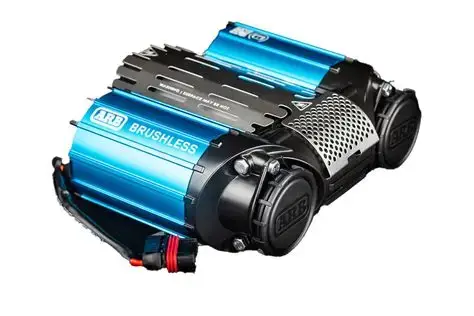
Heavy-duty portable compressors are the strongest all-around choice for many active 4x4 owners. Usually supplied in a carry bag with heavy battery clamps and a longer hose, they offer meaningful airflow without requiring vehicle modifications. Their trade-off is bulk. You need to secure the bag properly and protect it from sand, water, and cargo movement.
Onboard air systems are ideal for drivers who want fast, repeatable operation and may also use air tools, lockers, or tank storage. They require professional installation, careful wiring, and a suitable protected location. The convenience is excellent, but installation quality becomes part of the safety equation. Poor routing, undersized wiring, or an exposed fitting can create problems far beyond a slow inflation time.
Power Connections, Hoses, and Gauges Are Not Minor Details
A capable compressor can still disappoint if its supporting components are weak. For heavy-duty inflation, connect directly to the vehicle battery with proper clamps. A 12-volt accessory socket is convenient but often cannot safely handle the current drawn by a high-output compressor. Heat at the plug, voltage drop, and blown fuses are signs that the connection is not built for the load.
Check cable length before you buy. The compressor must reach the battery and all four tires without stretching cables across sharp edges or hot components. A long, flexible air hose makes the process calmer and keeps the compressor in a stable position away from the wheel. Heat-resistant hoses and threaded or secure push-on chucks are worth having. A loose connector that hisses through a five-minute fill becomes infuriating after the third tire.
Built-in analog gauges are useful for a quick reference, but they are not always precise. A separate quality tire-pressure gauge remains the better tool for setting final pressure. Digital gauges can be easier to read at night, though they depend on batteries and can be vulnerable to impact. Whichever style you choose, compare it occasionally against a known accurate gauge.
Heat Management and Sand Discipline
Compressor heads, hoses, and fittings become extremely hot. Place the unit on level ground, away from dry grass, fuel containers, loose recovery straps, and the vehicle’s paintwork. Do not carry it by the head immediately after use. Let it cool before packing it away.
Sand is equally unforgiving. Keep dust caps on connectors, avoid placing open fittings directly in fine sand, and shake out the bag before storage. After beach use or a wet wadis crossing, inspect clamps and connectors for corrosion. Equipment care is not glamorous, but neglected equipment is most likely to fail when the group needs to move.
A Practical Inflation Standard for Desert Convoys
Efficient inflation is a team habit. Park with enough space for vehicles to pass safely, keep the engine running if your vehicle manual permits it, and avoid blocking the exit point. Before connecting, inspect each tire for sidewall damage, embedded debris, or a bead issue. A compressor can restore pressure, but it cannot make a damaged tire safe.
Use the same process every time: connect securely, inflate in intervals, check pressure with a reliable gauge, then replace valve caps. Do not guess based on how firm a tire looks. Final road pressure should follow the vehicle and tire manufacturer guidance, adjusted appropriately for load and conditions.
A four-tire inflation kit can save considerable time when paired with a high-output compressor, but it adds complexity. Equalizing lines, valves, and couplers need to be leak-free and properly maintained. For newer drivers, one tire at a time is often the best way to learn what normal pressure, hose temperature, and compressor behavior look like. Speed comes after competence.
What We Would Choose for Different Drivers
A new desert driver with standard-size tires should choose a reputable direct-to-battery compressor with a clear gauge, reliable hose, and enough duty cycle to complete four tires without drama. Avoid novelty designs and ultra-cheap units that offer big pressure claims without meaningful airflow data.
A regular weekend driver should step up to a heavy-duty portable unit with strong airflow, a protected carry case, replacement parts availability, and a proven cooling design. This is the sweet spot for most organized drives and training days.
An expedition-focused driver with larger tires, heavier loads, and remote-route ambitions should consider premium twin-cylinder portable air or a professionally installed onboard system. Redundancy also has value on remote travel. A simple backup inflator or a plan to share equipment within the convoy is responsible preparation, not excess gear.
At Dubai Offroaders, vehicle preparation is treated as a shared responsibility because mutual support begins before the convoy moves. Bring equipment that matches your vehicle, know how to operate it, and do not rely on another driver to solve a predictable problem.
The compressor you carry does not need to be the most expensive item in your kit. It needs to be honest about its capability, maintained between drives, and ready to work when the desert day is over. Test it at home, learn its limits in a controlled setting, and pack it where you can reach it without unloading half your vehicle. That small discipline keeps the end of every adventure as dependable as the start.
Remember: Lower tyre pressures to 15–18 PSI before touching sand to expand your longitudinal footprint. Never attach a snatch strap to a tow ball or bumper, and always keep both thumbs on the outside of the steering wheel rim.
Community Discussion0
Open public discussion. Share your thoughts, ask questions, or connect with certified marshals and fellow drivers.



No comments yet — be the first to break the desert silence!